Appium vs XCUITest for Cross-Platform Automation
XCUITest runs faster and more reliably, but only works on iOS.

The automation testing market hit $34.64 billion in 2024, and it's headed toward $197 billion by 2034. Mobile testing alone is growing at a 16.8% compound annual rate. None of that growth explains the decision that actually matters: pick the wrong framework for iOS and Android automation, and the mistake compounds every sprint after. Appium is the wrong default for a huge share of the teams that reach for it first, and this piece explains why, then explains where it's still the right call.
What Appium and XCUITest are, and how they differ by design
XCUITest is Apple's own UI testing framework. It ships inside Xcode, built on the XCTest suite, and has been around since iOS 9.3. Tests get written in Swift or Objective-C, and there's nothing extra to install. Open Xcode: XCUITest is already sitting there, wired into the same toolchain a Swift developer already uses to build the app.
Appium takes the opposite approach. It's open-source, built on the WebDriver protocol, and designed to automate native, hybrid, and mobile web apps across iOS, Android, and Windows from one framework. Client libraries exist for Java, Python, JavaScript, Ruby, and C#, so a team isn't locked into one language to write its tests.
Appium doesn't replace XCUITest on iOS. It sits on top of it, and that's the detail people miss when they treat the two as competitors. Appium's own documentation says its iOS driver "leverages Apple's XCUITest libraries under the hood in order to facilitate automation of your app," which is a polite way of saying every test command travels a chain: the Appium client sends it to the Appium server running on Node.js, which passes it to WebDriverAgent, which calls the XCUITest APIs, which finally reach the device. XCUITest is Appium's engine on iOS, not its rival.
How the translation layer shapes speed and reliability
XCUITest doesn't spin up a server, make a network hop, or translate anything between the test code and the UI thread. The test runs in-process, synced directly with the app it's testing.
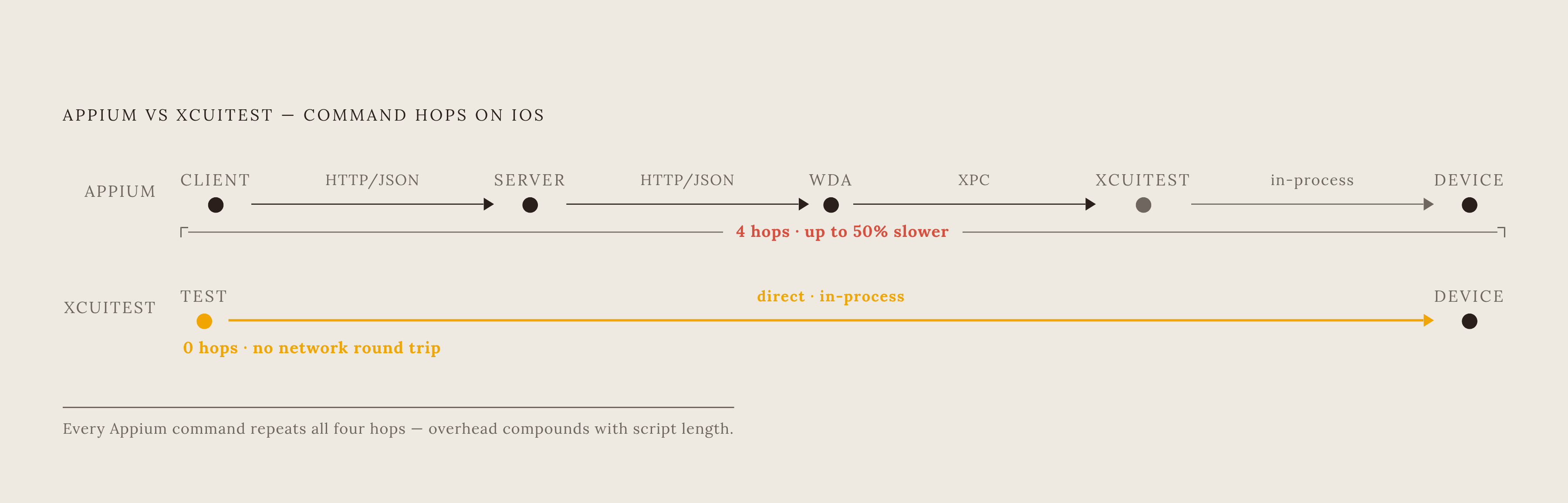
Appium can't offer that. Every command makes a round trip: HTTP request to the Appium server, forward to WebDriverAgent, forward again to the XCUITest API, out to the device, and back the same way in reverse. That's four hops for a single tap, repeated for every line in a script.
Execution time shows the gap. XCUITest commands can run up to 50% faster than Appium's equivalent on iOS. Widen the lens to native versus wrapper more broadly: frameworks like Espresso and XCUITest, which run inside the app's own process, tend to execute 3 to 6 times faster than Appium, because Appium pays a network and translation tax on every command it issues, not just the slow ones.
Speed isn't just a developer-patience problem. Every extra hop is another place a timeout, a dropped connection, or a race condition can turn a passing test flaky, and that's the real cost hiding inside the speed gap. A suite that runs ten thousand times a month doesn't fail ten thousand times for real reasons; it fails a chunk of that on infrastructure noise, and someone has to triage each one to find the handful that mattered. Fewer hops means fewer flakes. Teams that pick Appium for its reach across platforms need to accept that trade going in, not discover it six months into a suite that's already built.
The maintenance cost that accumulates over time with either tool
Both frameworks share the same underlying fragility. Tests target accessibility identifiers and specific spots in the element hierarchy, and any UI change that shifts those breaks the test, whether it's written in Swift for XCUITest or Python for Appium. That cost sits inside selector-based testing itself, not inside either tool specifically, and no framework choice makes it disappear.
Appium's added burden comes from what wraps around the selectors. Estimates put engineers spending 20% to 30% of sprint capacity writing, fixing, and triaging Appium tests, and other reporting puts the number higher still: 30% to 50% of QA time going toward fixing broken Appium selectors alone. Authoring pace tells the same story. Teams often produce around 15 new Appium tests a month, a rate driven more by selector upkeep and environment configuration than by the difficulty of the app logic under test.
Then there's WebDriverAgent, Appium's iOS intermediary, which needs its own compiled build signed with a valid Apple developer certificate, deployed separately to every device in the test pool. Running twenty devices in parallel means keeping twenty WDA instances alive, each one a fresh point of failure that has nothing to do with the app under test. That's the cost most teams underestimate before they've run a real device farm for a month. It's the cost most teams underestimate before they've run a real device farm for a month.
Appium's current state under version 3
Appium 1.x support ended January 1, 2022, and it's genuinely broken against current iOS and Android versions now. A team still running it in 2026 is testing against a moving target using a tool that stopped moving four years ago. That's not a defensible position for anyone shipping to current OS versions.
The real architectural shift came after 1.x. Appium turned from one monolithic server into a modular platform, where drivers like xcuitest or uiautomator2 install and update independently through the command line, without forcing a full server upgrade every time. That decoupling is a large part of why Appium has kept pace with Apple and Google's OS releases instead of falling permanently behind them, the way the 1.x line eventually did.
Appium 3 went generally available in August 2025, and by July 2026 the stable line sat at version 3.6.0, released July 25 of that year. The update itself is incremental rather than revolutionary, but it signals active maintenance, and that's the thing that should decide whether a team builds on Appium 3.x or looks elsewhere: not the feature list, the maintenance signal.
Where platform strategy determines the decision before anything else
XCUITest covers iOS, iPadOS, and macOS. No Android support exists, and none is coming, because Apple built XCUITest for its own platform, not as a gap to fill later. Calling that a limitation misreads what the tool is for.
Appium is the only framework here that tests iOS and Android from one shared codebase, and it stretches further into Windows and hybrid or mobile-web apps. That reach costs something, though. Cross-platform suites demand a lot more effort than a single-platform suite looks like it should, because platform-specific selectors and behavioral quirks leak through even when the test logic is nominally shared.
WebView content draws the sharpest line between the two. XCUITest has limited visibility into WKWebView content: as far as XCUITest is concerned, the WebView is largely opaque and not fully accessible to the test layer. Appium handles this differently. It switches between native context and WebView context inside the same test session, and that matters enormously for any app leaning on hybrid screens, embedded checkout flows, or web-rendered content sitting inside a native shell. An app with a checkout page rendered in a WebView simply can't get real test coverage from XCUITest alone. That's not a close call.
How team language skills and existing toolchain shape what's viable
XCUITest requires Swift or Objective-C. There's no way around that. Swift is the standard choice heading into 2026, and while Objective-C still works, new test code rarely gets written in it anymore. Beyond language, XCUITest needs macOS and Xcode to run at all, so a team without Apple developer machines in its infrastructure can't use it. That's a hard constraint, full stop, not a preference someone can negotiate around with a clever CI setup.
Appium removes both walls. It accepts any WebDriver-compatible language, so a QA engineer who already writes Python or JavaScript can start automating iOS tests today without learning Swift first. That's not a small convenience for teams where mobile QA grew out of a web QA function rather than a dedicated iOS engineering group, and it's a meaningful advantage for teams whose QA function grew out of web automation rather than native iOS development.
The deeper reason this matters: Appium implements the same W3C WebDriver model that Selenium uses for web automation. Client libraries, waiting strategies, and reporting pipelines a team already built for Selenium tend to carry over to mobile with far less relearning than jumping entirely into Apple's native tooling would demand.
CI/CD integration and real-device testing costs at scale
Appium's ecosystem is mature by now. It plugs into Jenkins, GitLab, and GitHub Actions without much friction, and device cloud providers, BrowserStack, Sauce Labs, and LambdaTest among them, treat Appium support as a baseline expectation rather than an add-on. BrowserStack's pricing starts at $199 a month for a single parallel session, and that sets a real floor under what running Appium at scale in the cloud actually costs once a team wants more than one device running at a time.
Automating a manual regression pass across two platforms at once rather than running it twice by hand tends to produce meaningful time savings, which is one of the more common justifications teams give for adopting Appium.
The scaling bottleneck for Appium on iOS comes back to WebDriverAgent again. Each device in a parallel pool needs its own compiled, signed, running WDA instance, and managing that across a device farm is the operational tax that dominates most Appium CI conversations once volume climbs past a handful of devices.
XCUITest's CI complexity looks different. It needs Apple Silicon machines to keep simulator launch times reasonable, plus ongoing Xcode version management, simulator caching, careful parallel execution setup, and converting .xcresult files into whatever format a reporting pipeline expects. Xcode Cloud is Apple's native answer, though iOS builds can run slow enough that CI costs climb higher than teams expect going in.
A side-by-side summary of when each tool fits
XCUITest makes sense when the app lives entirely inside Apple's world (iOS, iPadOS, or macOS only) and the team already writes Swift or Objective-C day to day in Xcode. Pick it when execution speed and low flakiness on iOS specifically outweigh everything else, when Apple Silicon CI infrastructure already exists, and when the app has no WebView content that tests actually need to reach inside.
Appium fits a different shape of team, and it's the correct call more often than the "just use XCUITest for iOS" crowd admits, at least once Android enters the picture. Choose it when the app ships on both iOS and Android and a shared codebase actually saves real effort, when the QA team writes Java, Python, JavaScript, Ruby, or C# and has no bandwidth to pick up Swift just for testing, and when a web suite already exists on another framework that the team wants to extend into mobile rather than rebuild from scratch. It's also the stronger option when the app carries real WebView or hybrid content, or when device cloud flexibility across BrowserStack, Sauce Labs, and LambdaTest matters to the workflow. Anyone choosing Appium in 2026 should build on the 3.x line without exception. The 1.x branch reached end of support on January 1, 2022, and there's no reason left to start there.
Neither tool is right for every app, and pretending otherwise wastes a team's time. Flutter apps use a custom rendering engine that bypasses the element discovery both frameworks depend on, so neither one gets a clean read on the UI tree, and teams building Flutter apps need to look elsewhere. Once selector maintenance becomes the dominant line item in a team's testing budget rather than an occasional cost, teams should ask whether a different approach, AI-driven visual testing or a YAML-based tool, solves the actual problem better than squeezing more optimization out of the selector-based model these two frameworks share.
AI-driven testing agents and alternatives alongside these two frameworks
The choice between these two frameworks used to be the whole conversation. That changed as more options entered the field: Autify's 2026 framework comparison notes that teams now choose from native frameworks, lightweight declarative tools, and AI-driven agents that adapt to UI changes on their own, without a human rewriting the selector every time a button moves three pixels to the left. The binary this piece has walked through sits inside a wider field now, not above it.
Maestro is one of the more visible entrants. It's YAML-based, works across both iOS and Android, and builds in flakiness handling and automatic waits, so test authors spend less time hand-tuning timeouts. Installation is a single binary, the core framework is free, and cloud execution on Maestro Cloud runs about $250 per device per month for teams that want managed infrastructure instead of running their own. Maestro doesn't currently support physical iOS devices natively for local testing, though, and that gap matters for any team that needs on-device, not simulator, coverage as part of its regular suite.
None of this displaces Appium or XCUITest. It does mean the decision a mobile team faces now branches more than it did a couple of years back, and the right branch still comes down to the same three questions this piece opened with: what platforms the app actually targets, what language the team already writes fluently, and how much ongoing maintenance the organization can absorb before that cost quietly eats the delivery schedule alive.